
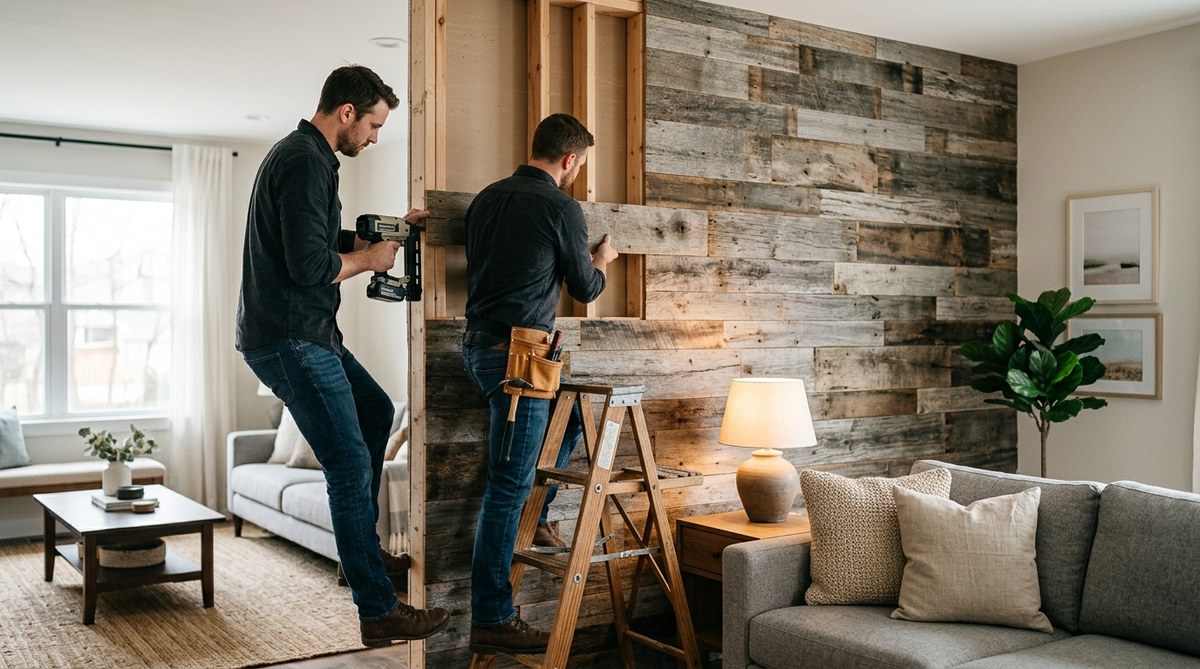
A blank wall can feel like a missed opportunity. You walk into your living room, bedroom, or home office, and there it is. A flat, neutral surface that does nothing to reflect your style. Reclaimed wood changes that. It adds texture, warmth, and a story that new lumber just cannot match. Whether you pull boards from an old barn, a pallet recovery yard, or a supplier of salvaged timber, the result is a wall that feels alive. This guide walks you through exactly how to create a reclaimed wood accent wall, from choosing your material to the final nail.
Building a reclaimed wood accent wall is a weekend friendly DIY project that transforms any room. Start by sourcing quality wood and acclimating it indoors. Prepare your wall with a moisture barrier and solid backing. Use a mix of plank widths and a staggered layout for a natural look. Secure each board with finish nails and a construction adhesive. Seal with a matte polyurethane for durability. The whole process takes one to two days and costs far less than a custom built feature wall.
Why Reclaimed Wood Works So Well in a Home
Reclaimed wood brings a layer of history into your space. Each plank carries marks from its past life: nail holes, saw kerfs, weathering, and color shifts that happened over decades. This patina is impossible to fake with new wood. It also helps the environment. By reusing timber that would otherwise end up in a landfill, you lower the demand for freshly cut trees. An accent wall made from salvaged lumber becomes a conversation piece. Guests will run their fingers over the grain and ask where you found it.
Another advantage is the natural variation in tone. New wood from a lumberyard tends to look uniform. Reclaimed boards offer a palette of grays, browns, ambers, and even hints of red. This variety gives your wall depth. It works in modern farmhouse, industrial loft, rustic cabin, and even coastal style rooms.
Choosing the Right Reclaimed Wood for Your Wall
Not all reclaimed wood is the same. Different sources yield different looks, and some require more prep work than others. Below is a breakdown of your most common options.
| Source | Typical Look | Prep Required | Best For |
|---|---|---|---|
| Barn wood | Weathered gray, silver, long planks | Low. Most is dry and stable. | Living rooms, bedrooms, feature walls |
| Pallet wood | Mixed species, nail holes, rough texture | High. Must disassemble, sand, and treat. | Budget builds, rentals, small accents |
| Salvaged flooring | Tongue and groove, milled edges, tight grain | Low to medium. May need cleaning and wax removal. | Formal spaces, dining rooms, home offices |
| Reclaimed timber from mills | Thick slabs, dimensional lumber, raw edges | Medium. Requires planing or sanding for flatness. | Statement walls behind a fireplace or TV |
| Faux reclaimed planks | Manufactured, pre finished, lightweight | None. Ready to install out of the box. | Renters, bathrooms, low maintenance needs |
If you are unsure where to start, try barn wood. It is often already dry, stable, and cut into manageable widths. You can find it at architectural salvage yards, online marketplaces, or through local demolition contractors. Always ask about the wood’s history. Avoid wood that shows signs of rot, insect damage, or chemical treatment unless you are prepared to seal it properly.
Tools and Materials You Will Need
Gather everything before you start. This keeps the workflow smooth and prevents mid project runs to the hardware store.
Materials
- Reclaimed wood planks (enough to cover your wall plus 10 percent extra for waste)
- Construction adhesive (PL Premium or similar)
- 1 1/4 inch finish nails
- Wood filler (color matched to your wood)
- Sandpaper (80 grit and 120 grit)
- Tack cloth
- Matte polyurethane or wax finish
- Painter’s tape
- Plastic sheeting (to protect floors)
Tools
- Measuring tape
- Level
- Stud finder
- Circular saw or miter saw
- Nail gun or hammer
- Jigsaw (for cuts around outlets)
- Pry bar
- Shop vacuum
- Safety glasses and dust mask
Do not skip the stud finder. While adhesive holds the planks to the drywall, nails into studs provide the real grip. This is especially important for heavier boards.
How to Create a Reclaimed Wood Accent Wall
Follow these steps in order. Rushing any stage can lead to gaps, warped boards, or a wall that does not sit flat.
1. Acclimate the Wood Indoors
Stack your planks in the room where they will be installed. Leave them for at least 48 hours. Wood expands and contracts with humidity. By letting it adjust to your home’s climate, you reduce the chance of boards shifting after installation. Keep them off the floor on a few strips of scrap wood. This allows air to circulate underneath.
2. Prepare the Wall Surface
Start with a clean, dry wall. Remove any outlet covers, switch plates, and nails. Fill large holes with spackle and let them dry. If your wall has glossy paint, scuff it with 80 grit sandpaper so the adhesive bonds better. Wipe down the surface with a tack cloth.
Lay plastic sheeting on the floor. This catches dust and adhesive drips.
3. Sort and Arrange Your Planks
Lay the boards on the floor in front of the wall. Mix wide and narrow planks. Alternate light and dark tones. Place boards with heavy character (knots, deep grain, nail holes) at eye level where they will get noticed. Put plainer boards near the top and bottom. Take a photo of your layout so you can reference it during installation.
Expert advice: “Never install a board that is still wet or covered in dirt. Clean each plank with a stiff brush and a damp cloth. Let it dry fully before you even think about cutting it.” This tip comes from a salvage yard owner in Ohio who has supplied wood for over 200 accent walls.
4. Cut and Fit Each Plank
Measure the height of your wall. Cut each plank about 1/4 inch shorter than the measurement. This gap at the top and bottom allows for expansion. You will cover it with trim later. Use a circular saw for straight cuts. Use a jigsaw for cuts around outlets and light switches. Cut slowly. Reclaimed wood can have hidden nails that will ruin a saw blade if you hit them.
5. Apply Adhesive and Nail
Run a zigzag bead of construction adhesive on the back of the plank. Press it firmly against the wall. Use a level to check that the board is straight. Nail it into place with finish nails every 12 inches along the length. Aim for studs where possible. If you hit a stud, the nail will hold with more force. If you miss, the adhesive will still hold the board, but the nail keeps it tight against the wall while the glue dries.
6. Stagger the End Joints
Do not line up the seams between boards in a grid pattern. Stagger them randomly. If a plank ends at 48 inches, the next row should have its joint around 24 or 36 inches. This gives the wall a natural, organic feel. It also hides any small gaps that might open over time.
7. Continue Until the Wall Is Covered
Work from left to right or right to left. Fit each plank snugly against its neighbor. Some gaps are fine. They add to the rustic look. Large gaps (wider than 1/4 inch) should be filled with a thin strip of wood or wood filler. If you run into a board that is warped, set it aside and use a straighter one instead.
8. Add Trim and Finish the Edges
Install a piece of trim at the top, bottom, and both sides of the wall. This covers the expansion gaps and gives the wall a clean border. Use the same reclaimed wood for the trim if you have enough, or use a painted trim that matches your baseboards. Nail the trim in place and fill the nail holes with wood filler.
9. Sand and Seal
Lightly sand the entire wall with 120 grit sandpaper. Focus on any rough edges or splinters. Wipe the dust away with a tack cloth. Apply a coat of matte polyurethane using a foam brush or a lint free cloth. Let it dry for the time listed on the can. Apply a second coat if the wall will be touched often. The seal protects the wood from dust, moisture, and fading.
Common Mistakes and How to Avoid Them
Even experienced DIYers make errors on their first accent wall. Here are the most frequent ones and the fixes.
| Mistake | Why It Happens | How to Avoid It |
|---|---|---|
| Boards cup or warp after installation | Wood was not acclimated | Always let wood sit in the room for 48 hours before starting |
| Gaps appear between planks | Boards were not straight or were pushed too tight | Leave a consistent 1/8 inch gap and use spacers |
| Adhesive oozes between boards | Too much glue applied | Use a thin zigzag bead and wipe excess immediately |
| Finished wall looks flat | All planks are the same width and color | Mix widths from 3 to 8 inches and rotate light and dark boards |
| Nails pop out after a few weeks | Nails missed studs or were too short | Use 1 1/4 inch nails and aim for studs whenever possible |
Design Ideas to Make Your Wall Stand Out
A reclaimed wood accent wall does not have to cover an entire surface. Try one of these approaches instead.
- Half wall. Install wood on the lower half of the wall and paint the upper half a neutral white or soft gray. This keeps the room feeling open while still adding texture.
- Behind the bed. Place the wall behind your headboard for a cozy, hotel like feel. No headboard needed if the wood itself becomes the focal point.
- Fireplace surround. Use reclaimed wood to frame a modern electric fireplace or a traditional hearth. The contrast between rough wood and sleek fire creates a strong visual anchor.
- Ceiling accent. Take the wood to the ceiling instead of the wall. A reclaimed wood ceiling in a dining room or entryway feels unexpected and dramatic.
- Vertical orientation. Install the boards vertically instead of horizontally. This draws the eye upward and makes a low ceiling feel taller.
If you are working with a small room, choose lighter boards with more gray and less amber. Dark wood can shrink a space. Light wood keeps it airy.
If you enjoyed this project, you might also like learning how to build a custom bookshelf without professional help for your new accent wall.
Maintaining Your Reclaimed Wood Accent Wall
Reclaimed wood is durable, but it still needs care. Dust the wall every few weeks with a soft brush attachment on your vacuum. Avoid wet cleaning. Water can seep into the gaps and cause the wood to swell. If a board gets stained, wipe it with a barely damp cloth and dry it immediately. Reapply a coat of polyurethane every two to three years if the wall gets heavy use.
Sunlight will slowly change the color of the wood. Boards near a window may lighten or darken faster than those in the shade. This is part of the charm. The wall will continue to age and develop character, just like the wood did in its previous life.
The Real Cost of a DIY Reclaimed Wood Accent Wall
One of the biggest questions is always about money. Here is a realistic budget breakdown for a standard 8 by 12 foot wall (96 square feet).
- Reclaimed wood: $200 to $800 depending on source and species
- Construction adhesive (two tubes): $12
- Finish nails (one box): $8
- Wood filler: $6
- Sandpaper and tack cloth: $10
- Polyurethane (one quart): $22
- Trim pieces: $30 to $60
Total range: $288 to $918. Compare that to a custom stone accent wall or a professional wallpaper installation, and reclaimed wood comes out ahead on both cost and impact.
If you are on a tighter budget, check out easy DIY storage solutions for small spaces that use reclaimed wood scraps left over from your wall.
Your Next Weekend Project Starts Here
A reclaimed wood accent wall is one of those rare projects that delivers immediate visual payoff. You do not have to wait for the paint to dry or the wallpaper paste to set. The moment you nail the last board in place, the room feels different. It has texture. It has warmth. It has a story.
Start by sourcing your wood. Visit a salvage yard. Call a local barn demolition crew. Check Facebook Marketplace for someone giving away old fence boards. The hunt is part of the fun. Once you have your planks, follow the steps in this guide. Take your time sorting the layout. Do not skip the acclimation step. Seal the wall when you are done.
You will walk into that room every day and see something you built with your own hands. That feeling never gets old.
For more hands on home projects, check out transform your living space with simple DIY home decor projects that pair beautifully with a new accent wall.